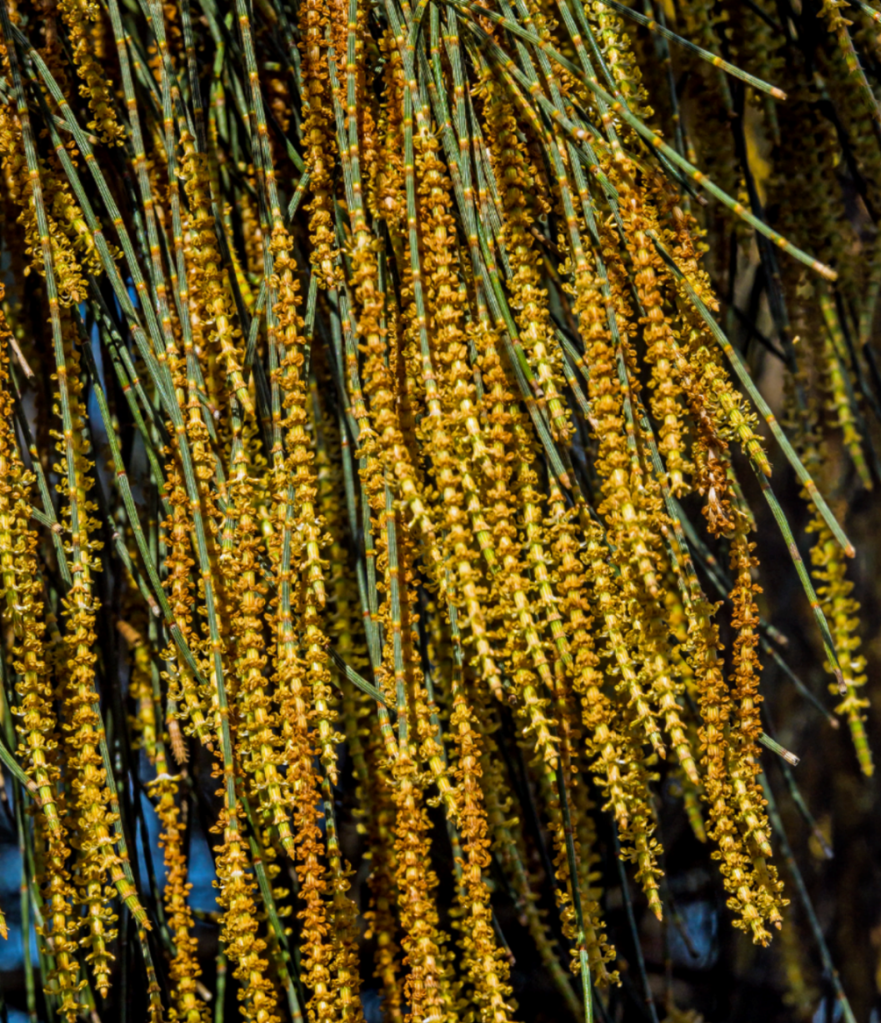
photo: male tree pollen catkins https://www.nationalarboretum.act.gov.au/living-collections/forests-and-trees/forest-100
According to the calendar, it’s still winter here in August, but really, it’s ‘sprinter’ – that time of year when the days suddenly have a bit more warmth in them, the sun begins to shine a little more, but there’s still quite a few rainy days. You can feel the hint of spring in the air. It’s not quite winter, but it’s not quite fully spring … it’s sprinter!
The grass starts to grow, the flowers start to bloom, and the bees are busy at every opportunity to leave the hive when it’s warm enough to do so; to take wee breaks, and to gather pollen for making ‘bee bread’ to feed to soon-to-be rapidly increasing numbers of brood to feed.
Thus week, on a calm sunny day I heard a loud humming overhead as I was out working near some Drooping She-Oak trees, Allocasuarina verticillata. Bees!
Drooping She-Oaks trees are separately male (pollen-bearing) or female (seed cone-producing) trees. This particular tree was a male tree, brimming with pollen catkins, and the bees were in full flight between the catkins, busily gathering pollen to pack into their pollen sacs on their legs to take back to the hives.
Interestingly, Drooping She-Oaks are wind-pollinated, which means they rely on the wind to transport pollen to the female flowers, rather than enticing insects with a nectar reward to move the pollen from flower to flower.
Wind-pollinated species need to produce copious amounts of pollen to allow for the random effects of the wind taking the pollen in the direction of other flowers on nearby trees, but it would be interesting to conduct experiments to determine how much of this pollen is collected by various insects.
Also of interest, is whether this pollen resource is accessed by native bees and insects to provision their food requirements.
In the case of honey bees removing some of this pollen from being wind-dispersed, it made me wonder how much they might be taking and if it’s likely to have an impact on the viability of the She-Oaks to successfully fertilise female flowers and for those flowers to form cones and set seed for future generations of She-Oak trees.
I think there’s a scientific experiment needing to be done there!
Another wind-pollinated species that bees adore for their pollen resources is olive trees, which are a fantastic source of pollen in early spring when the brood numbers start to expand and bees’ food requirements expand exponentially. Olive trees’ flowers have male and female parts, so bees may actually help pollinate olives as they move from flower to flower.
So, if you’re out in your garden, or on your farm, on a sunny day during ‘sprinter’ and you hear lots of buzzing in an olive tree or a She-Oak tree, look up and watch the busy life of bees in action. It’s a pollen party, and you’re invited!
Keep on buzzing!

female tree showing flowers and developing fruits (cones/nuts) https://earthone.io/plant/allocasuarina%20verticillata
 BUUKAAR WAARUUNG Boutique Apiary & Artisan Honey